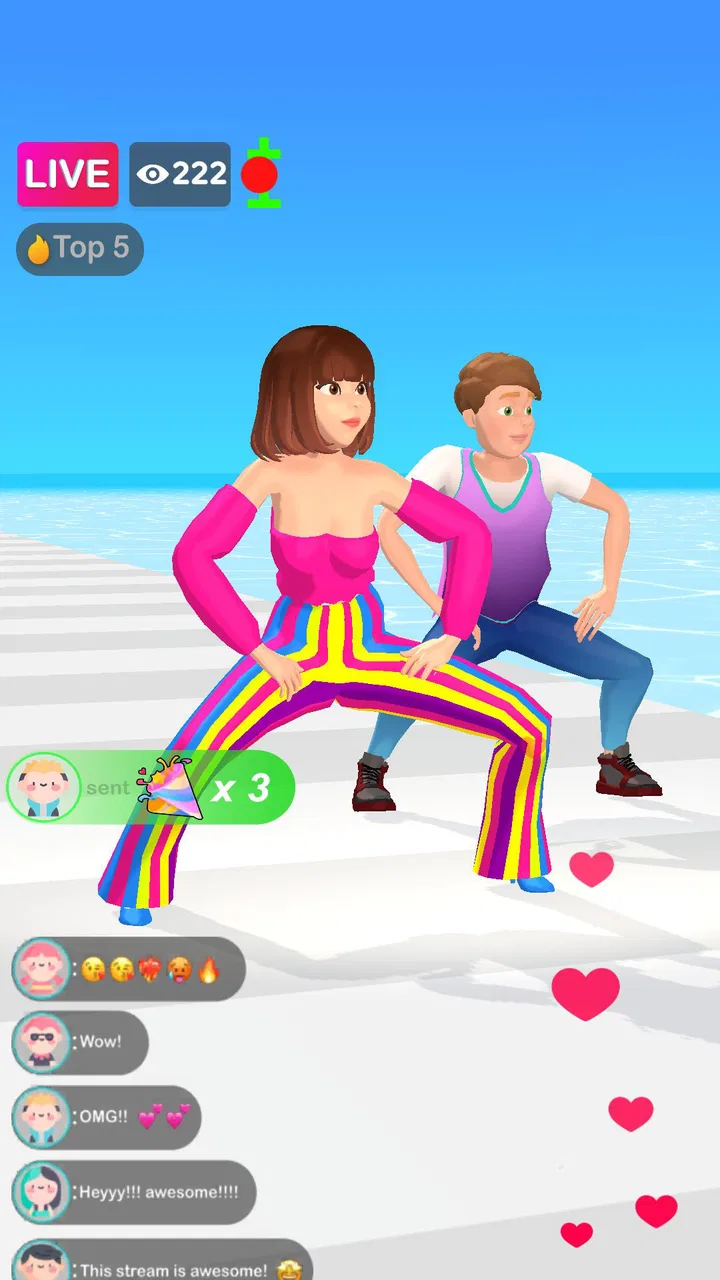
Streamer Rush: Dress & Impress
- 4.2
- Rating
- 10.00M
- Installs
- Free
- Price

 Analysis by App-foxy
I went into Streamer Rush: Dress & Impress expecting a light fashion game, but its real appeal is the way it turns presentation into a small performance. You are not simply choosing clothes and moving on. The game frames each decision around the idea of building an online persona, attracting followers, and shaping a recognizable fandom. That gives the dress-up format a clear reason to exist, even when the individual tasks remain simple.
This is a free simulation game from MagicLab, aimed at Teen players and available for devices running Android 8.0 or later. It has grown into a sizeable mobile release, with more than ten million installs and an average score of 4.2 from roughly ninety-two thousand ratings. Those figures suggest a broad audience, but they do not automatically make it a good fit for everyone. In my experience, the game works best for players who enjoy visual choices, quick feedback, and the fantasy of turning a personal style into a public identity.
The most important thing to understand before downloading it is that this is not a deep fashion design tool or a serious creator simulator. It is a casual, colorful interpretation of streaming culture, built around short decisions and immediate visual rewards. If you want relaxed sessions where you can experiment with an outfit and see how that choice affects your on-screen image, it has a pleasant rhythm. If you are looking for complex strategy, long-term resource planning, or a fully developed streaming career, the experience may feel too narrow.
You May Also Like

 Blood Strike: 2.5 Anniversary
Blood Strike’s Loadouts Turn Every Drop Into a Tactical Gamble
A close look at Blood Strike’s custom loadouts: how fast access to signature weapons reshapes its battle royale rhythm, rewards preparation, and narrows the gap between fights.

 Pandora - Music & Podcasts
Pandora’s Music Is Easy to Start, but Harder to Recover
Pandora’s strength is its low-effort path from a seed to a station. Its weak spot is how much confidence it asks you to place in connection, setup, and quiet recovery.

 8 Ball Pool
 Is Built on Rivalries, Rematches, and Routine
A close look at the rivalries, rematches, shared routines, and unanswered safety questions that turn a quick pool match into a persistent mobile community.

 Samsung Music
’s Quiet Strength Is Playing What You Already Own
Its reach comes less from spectacle than from dependable access to a personal library. That simplicity is both the app’s strongest retention engine and its ceiling.

 AccuWeather: Weather Radar
AccuWeather Review: A Quick, Clear Forecast for Everyday Decisions
For everyday plans, the best forecast is the one you can understand quickly. AccuWeather makes rain timing, radar, and local conditions easy to act on, with a few trade-offs.

 Hill Climb Racing
Why Hill Climb Racing Still Turns Crashes Into One More Run
A tiny car, a bumpy hill and one more upgrade: Hill Climb Racing keeps resurfacing because its simple chaos makes every near-miss feel personal.
More From Our News Desk



How the game turns style into a playable identity
I find it helpful to treat each styling choice as part of a recognizable on-screen persona, rather than as a one-off outfit puzzle. That shift makes small decisions—like whether to keep a look understated or give it a bold accent—feel more intentional, and it offers a useful lens for judging where the game’s presentation works best.
A first impression built around performance
The opening idea is easy to grasp: gain followers and create a fandom by presenting yourself well. That premise gives the game a stronger hook than a generic wardrobe simulator because every outfit is connected to an imagined audience. I found that connection useful even when I was making small choices. A jacket, hairstyle, or overall look felt less like decoration and more like part of a public image.
The visual direction is deliberately approachable. It uses the polished, exaggerated language common to mobile fashion games, where silhouettes need to read quickly and outfits need to look appealing at a glance. That choice suits the short-session format. I never had to study a screen for long to understand what kind of impression a look was trying to create.
There is also a useful distinction between dressing for personal taste and dressing for a particular moment. A look that I liked on its own did not always feel right for the imagined streaming persona. That tension gives the game some of its best small decisions. It encourages experimentation without requiring the player to understand complicated systems first.
One practical tip is to avoid changing every element at once when you are testing a style. I found it easier to notice what was helping or hurting the overall impression when I changed one major piece at a time. Starting with the outfit’s central item, then adjusting hair or accessories, makes the result easier to judge than replacing the entire appearance repeatedly.
A colorful world with a clear visual language
The setting is not presented as a realistic workplace simulation. It is a bright fantasy of online popularity, where the character’s appearance carries much of the storytelling. The game communicates status, personality, and ambition through clothing and presentation rather than through long explanations. That keeps the world readable, especially for players who prefer visual feedback to blocks of dialogue.
I like that the art direction supports the main fantasy instead of competing with it. The character is the focus, and the surrounding presentation exists to make the chosen look feel like an event. This is important because fashion games can easily become collections of disconnected menus. Here, the streaming theme gives those choices a common frame.
At the same time, the simplified style means players should not expect nuanced realism. The appeal comes from recognizable visual categories and bold combinations, not from accurate fabric behavior or detailed fashion history. Someone who enjoys creating highly specific, realistic outfits may find the presentation too stylized. Someone who wants instantly recognizable looks will probably appreciate the clarity.
The world language also makes the game approachable for younger players within its Teen rating, although the social-media-inspired premise may not appeal to every family. I would still treat it as a game about public image rather than a lesson in real online popularity. Its version of fandom is playful and compressed, designed to support the game loop rather than explain how actual communities work.
Sound, timing, and the feeling of a quick session
The mood depends on more than clothing. The presentation, transitions, and sense of movement help the game feel like a sequence of small public appearances instead of a static closet. I noticed that the experience is most enjoyable when I let the pace carry me forward rather than overthinking every selection.
That pacing is one of the game’s strengths and one of its limitations. Short decisions make it easy to play during a break, while waiting for transport, or when I only have a few minutes to spare. The downside is that players who want to linger over every detail may feel pushed toward the next result. The game is designed around momentum, not extended creative sessions.
The sound and visual feedback work best as a unified mood setter. They reinforce the idea that each appearance is a small show, giving ordinary wardrobe choices a little more energy. I would not describe the experience as musically ambitious, but it does not need to be. The important job is to keep the actions feeling connected and upbeat.
A useful way to play is to separate “creation time” from “progress time.” When I wanted to experiment, I treated a round as a visual test and paid attention to combinations. When I wanted a faster session, I made a confident choice and moved on. This simple distinction prevents the pacing from becoming frustrating, because I was no longer expecting every round to serve the same purpose.
Where the mechanics fit the theme
The central mechanics are easy to understand because they match the fantasy directly: choose a look, present it, and work toward greater recognition. That alignment matters. The game does not ask me to manage an unrelated economy before I can enjoy the fashion element. The main activity remains visible throughout the session.
Its simulation label should be read in a casual sense. This is a stylized simulation of being a streamer and building a following, not a detailed management game with elaborate scheduling, analytics, or business decisions. The distinction is important when deciding whether to install it. I would recommend it to someone who wants the feeling of creator progression without the workload of a full management simulator.
The free entry point is another reason it is easy to try. The game costs nothing to download, while optional purchases are priced at $2.99 to $3.99 per item. That makes it possible to sample the core experience before spending anything. My advice is to play long enough to decide whether the basic loop itself is satisfying. Purchases make more sense for someone who already enjoys collecting and customizing, not for a player hoping that spending will transform the game into a deeper simulation.
That trade-off is worth keeping in mind. In a dress-focused game, the desire for additional visual options can be stronger than the need for mechanical upgrades. If you are easily tempted by new appearance items, setting a personal limit before playing is sensible. The game’s appeal is tied to presentation, so optional purchases can feel more relevant than they would in a purely action-oriented title.
Everyday use cases and the right kind of player
I can see this working well for a player who has ten minutes before an appointment and wants something more interactive than scrolling through social media. A quick session can involve choosing a theme, refining the character’s appearance, and enjoying the result without committing to a long campaign. The streaming premise makes the activity feel purposeful even when the session is brief.
It is also a good choice for players who like visual experimentation but do not want the pressure of real-time competition. You can focus on the relationship between color, silhouette, and personality rather than worrying about reflexes. That makes it a comfortable option for casual players who enjoy seeing a character gradually become more distinctive.
I would be more cautious recommending it to someone who wants a realistic influencer simulator. The game does not replace a full management title, a creative design application, or a social platform. It compresses the idea of building a fandom into a friendly game loop. That simplification is exactly why it is accessible, but it also limits the depth of the fantasy.
Players who dislike repeated outfit decisions may also lose interest. The game’s identity is closely tied to appearance, so there is no point downloading it if dress-up is only a minor attraction for you. Likewise, anyone seeking a story-heavy adventure should look elsewhere. The setting supports the visual loop, but it is not the same as a large narrative world with extensive character development.
Small strategies that make the experience better
The first strategy I would suggest is to build a recognizable persona instead of treating every round as a random costume test. Think about whether you want the character to look playful, polished, dramatic, or relaxed, then let several choices support that direction. A consistent identity makes the progress fantasy more satisfying than chasing isolated items.
Second, judge the complete silhouette before worrying about tiny details. A strong main outfit can carry a look, while too many competing accessories can make the character feel visually confused. I found that simplifying a combination was sometimes more effective than adding another eye-catching piece. This is a useful lesson for the game because the presentation is viewed quickly, just as a stream thumbnail or profile image might be.
Third, use contrasting choices deliberately. If the clothing is visually loud, a calmer hairstyle or accessory can keep the result readable. If the main outfit is simple, one stronger accent can give it personality. This approach turns the game from a sequence of guesses into a small exercise in visual balance.
Finally, do not assume that the most elaborate option is automatically the best one. The streaming theme rewards a clear impression, and clarity often comes from restraint. I enjoyed the game more once I stopped trying to make every available choice compete for attention.
What the current release means for new players
The current version is 5.0.8, and the game has been available since September 7, 2021. For a new player, the practical takeaway is that this is an established release rather than a brand-new experiment. Its large install base and substantial number of written reviews also indicate that it has had time to attract a broad mobile audience.
That history does not remove the usual concerns around a free-to-play fashion game. The experience is still best approached with realistic expectations about repetition and optional spending. A mature release can feel smoother and more settled, but it does not automatically provide the depth of a premium game or a dedicated creative tool.
Device compatibility is reasonably broad for modern Android users because the minimum requirement is Android 8.0. I would still think about screen size and comfort before deciding how often to play. The game’s visual choices benefit from being easy to see, and a larger display may make comparing outfits more enjoyable than a very small phone screen.
How it compares with familiar alternatives
Compared with a traditional dress-up game, this one has a more focused identity because the character is framed as a streamer rather than simply a model. That theme gives the choices a sense of audience and progression. The trade-off is that players who want pure wardrobe freedom may prefer a game centered entirely on collecting and styling without the follower fantasy.
Compared with a serious simulation game, it is far more immediate. There is less mental overhead, and I can understand the purpose of a session almost instantly. The cost of that accessibility is strategic depth. You are not managing a complicated creator career; you are enjoying a stylized version of one through appearance and presentation.
Compared with a social platform, it is safer as a contained fantasy because the audience is part of the game rather than a real group of people judging your posts. However, it cannot offer the genuine conversation, discovery, or community-building that a real platform provides. Anyone downloading it to replace social interaction will probably be disappointed.
Compared with a premium fashion title, the free entry point is attractive, especially for curious players. The optional item purchases mean that the long-term value depends on how much you enjoy the base loop and how comfortable you are with the spending model. For me, it is best viewed as a casual game to sample rather than a purchase decision that needs to be justified immediately.
My atmosphere verdict
Streamer Rush: Dress & Impress succeeds when its art direction, sound, and pacing all point toward the same fantasy: becoming visually memorable in a bright, simplified streaming world. The mechanics are not deep, but they are coherent. Choosing an outfit matters because the game presents appearance as the language of popularity, and the quick rhythm keeps that idea easy to engage with.
Its limitations are equally clear. The experience may become repetitive for players who need complex systems, extensive storytelling, or constant mechanical variety. The free-to-play structure also deserves a thoughtful approach, especially for anyone who finds cosmetic collecting difficult to resist. Those are not minor details; they determine whether the game remains relaxing or starts feeling like a sequence of prompts to spend.
For me, the strongest use case is a short, low-pressure session built around visual decisions. I would recommend it to friends who enjoy fashion games, colorful character presentation, and the playful idea of growing an online persona. I would skip it for anyone searching for realistic creator management or a substantial narrative campaign.
As a free simulation game from MagicLab, it offers an approachable way to explore that fantasy without demanding much time at once. The best reason to play is not the promise of becoming famous, but the pleasure of making a character look instantly recognizable. If that kind of visual storytelling sounds appealing, the game is worth trying; just keep its casual scope and optional purchases in mind before expecting more than a stylish, fast-moving dress-up experience.
FAQs for Streamer Rush: Dress & Impress
01What is Streamer Rush: Dress & Impress?
Streamer Rush: Dress & Impress is a mobile game where players navigate through various levels as a social media influencer. The objective is to collect followers, dress stylishly, and overcome obstacles to become a top-tier influencer. It combines elements of fashion, strategy, and endless runner gameplay.
02Is Streamer Rush: Dress & Impress free to play?
Yes, Streamer Rush: Dress & Impress is free to download and play. However, it does offer in-app purchases that provide players with additional outfits, accessories, and other enhancements. These purchases are optional but can enhance the gaming experience by unlocking premium content.
03What are the main features of Streamer Rush: Dress & Impress?
The game features engaging levels where players can customize their character’s appearance with trendy outfits and accessories. It also includes social media challenges, follower collection, and a leaderboard to compete with other players. The game regularly updates with new themes and challenges to keep it exciting.
04Do I need an internet connection to play Streamer Rush: Dress & Impress?
While an internet connection is required for downloading the game and accessing certain features such as leaderboards and social media challenges, the core gameplay can be enjoyed offline. However, playing online ensures access to the latest updates and content.
05Is Streamer Rush: Dress & Impress suitable for all ages?
Streamer Rush: Dress & Impress is designed for a wide audience, generally suitable for ages 12 and up. The game includes fashion elements and social media themes which appeal to teens and young adults. Parents should be aware of the in-app purchases and online interactions when allowing younger players.
Pros
- Engaging gameplay with unique challenges
- User-friendly interface and controls
- Regular updates with new features and levels
- Visually appealing graphics and design
- No intrusive ads interrupting gameplay
Cons
- Requires constant internet connection
- In-app purchases can be expensive
- Limited character customization options
- Occasional lag on older devices
- Battery consumption is relatively high

Streamer Rush: Dress & Impress
Gallery